
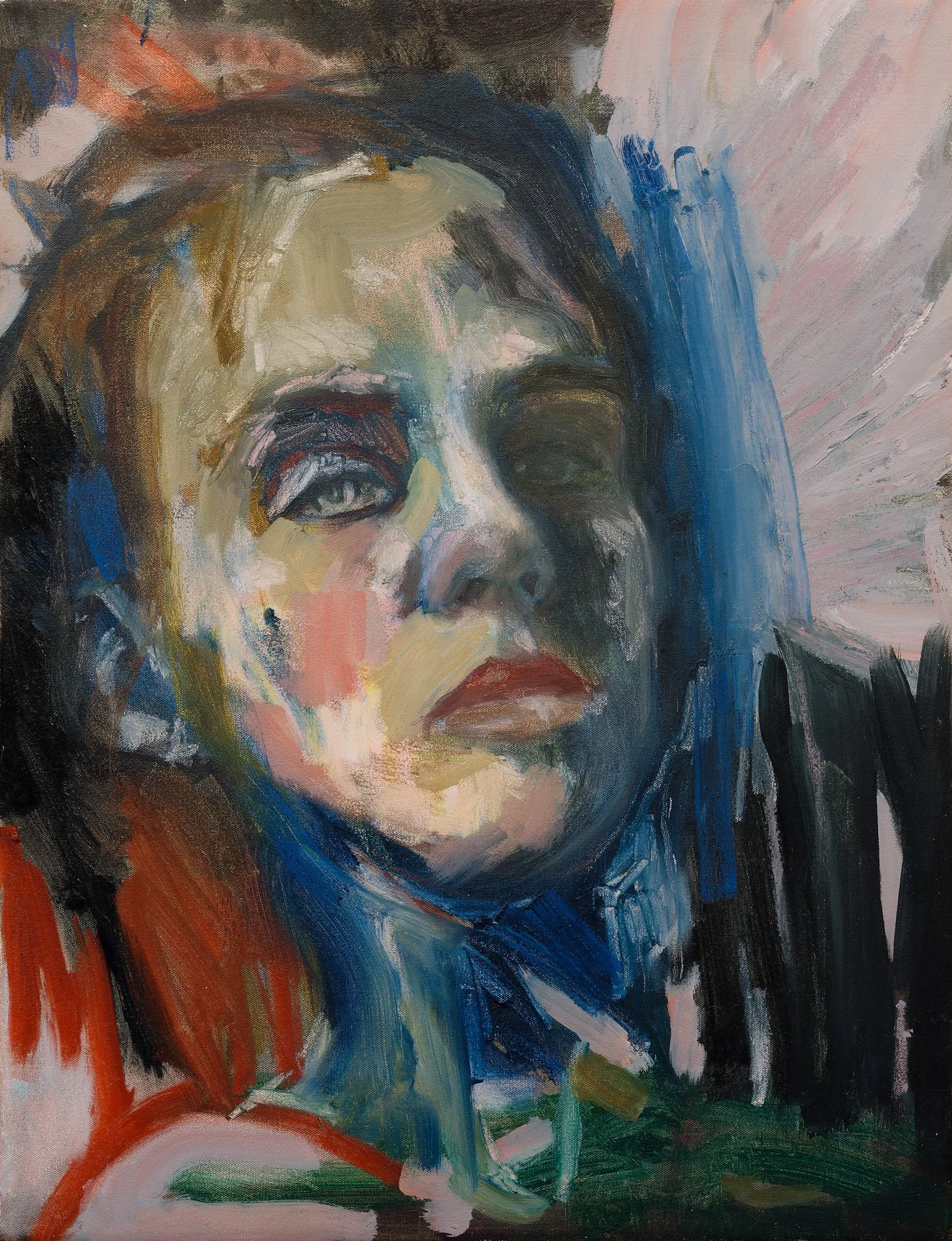
The 'bruised echoes' linger, embodied in the dissociated gaze. Bruise-like hues resonate throughout the composition, traces of a deeply personal journey.
This self-portrait is an attempt to sit with the inaccessible parts of myself. To reconcile feelings of powerlessness and violation while reaching for strength through the illusion of control, wrestling with the corrosive feeling that it was always my fault.
Intuitive strokes convey desperate attempts to understand and be understood. Shame and isolation wear me down until I am but a husk of my former self.

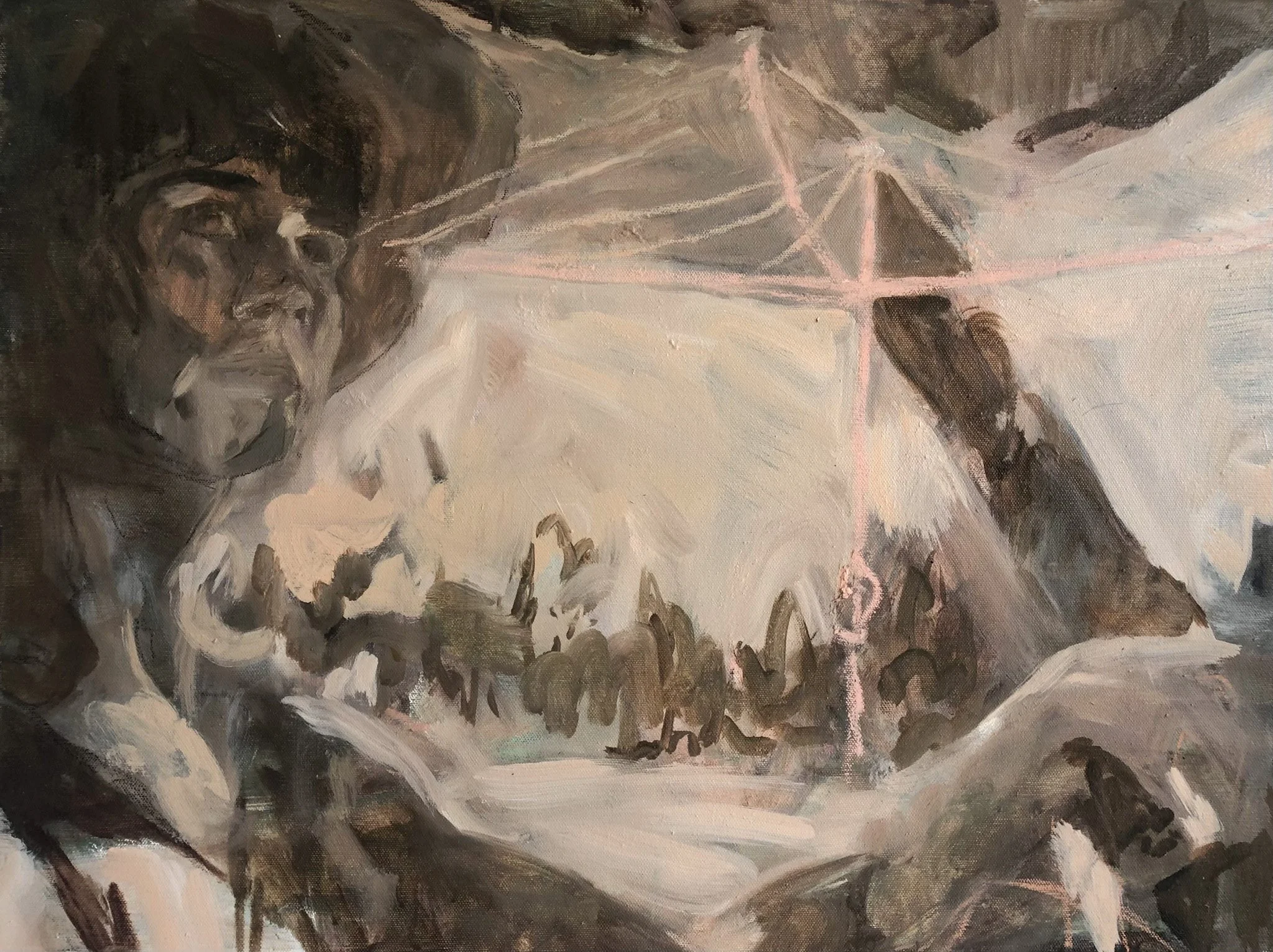
Moved by Alan Watts' reflections on finding peace and presence amid the chaos of modern life, I took a painting trip into nature, seeking stillness, solace, and space to think. Ironically, in trying to escape, I captured a moment that revealed the opposite. Reflected in the back window of my van, smartphone in hand, laundry strung behind me, I saw myself. I had romanticised disappearing into the wild, but there I was: connected, comfortable, tethered to the very world I had hoped to unplug from.
That vision became the seed for this painting. The washing line, a recurring motif in my work, took on symbolic weight. Intimate and exposed, the clothes reflect the mess and movement of being human. Laundry becomes a metaphor for self-reflection, healing, and showing up with honesty.
In a world of endless noise, stillness cannot be chased. It is something we can learn to access anywhere, if we are willing to stop, look, and listen. Alan Watts appears faintly in the window's reflection - a guide, a reminder, a quiet nudge back to centre. There is no final arrival. We are always in process, always beginning again.
This work is a meditation on solitude - the kind that restores rather than isolates.
Alone, but not lonely, I find myself in quiet communion with the open road and the vast stillness of Yuwaalaraay country. My thoughts may swirl, but the land anchors me.
When life feels overwhelming, I pack my paints and follow the pull of the horizon. In motion, I find pause.
Out here, the landscape becomes a salve. Observing shifts in colour and light gives shape to my inner world, allowing scattered sensations to settle. The act of painting becomes a grounding ritual, a way to stay present, to return to myself.

I imagine there is a moment, perhaps in death, or in the slow death of certainty, where you finally arrive. You have made the long ascent, endured the smoke and spectacle, only to find that the throne is empty. Or worse, occupied by someone who looks suspiciously like yourself.
At first, there is awe. Then disillusionment. Then clarity.
This painting began as an encounter with power, both the kind that rules from above, and the kind we surrender to without question. A conductor presides over seven hooded figures: faceless, obedient, indistinguishable. They wait for instruction. For meaning. For someone to tell them who they are. In the face of uncertainty, we are quick to outsource our inner knowing, distrusting our own intuition in favour of external authority.
Visually, the work draws on the haunted intensity of Goya's dark paintings and the solemn, visionary force of Doré's illustrations of the Divine Comedy: images shaped by fear, devotion, and the architecture of belief. But here, the architecture cracks. This work asks: what happens when the worshipper meets the maker, and the maker is no longer distant, but the divine within?
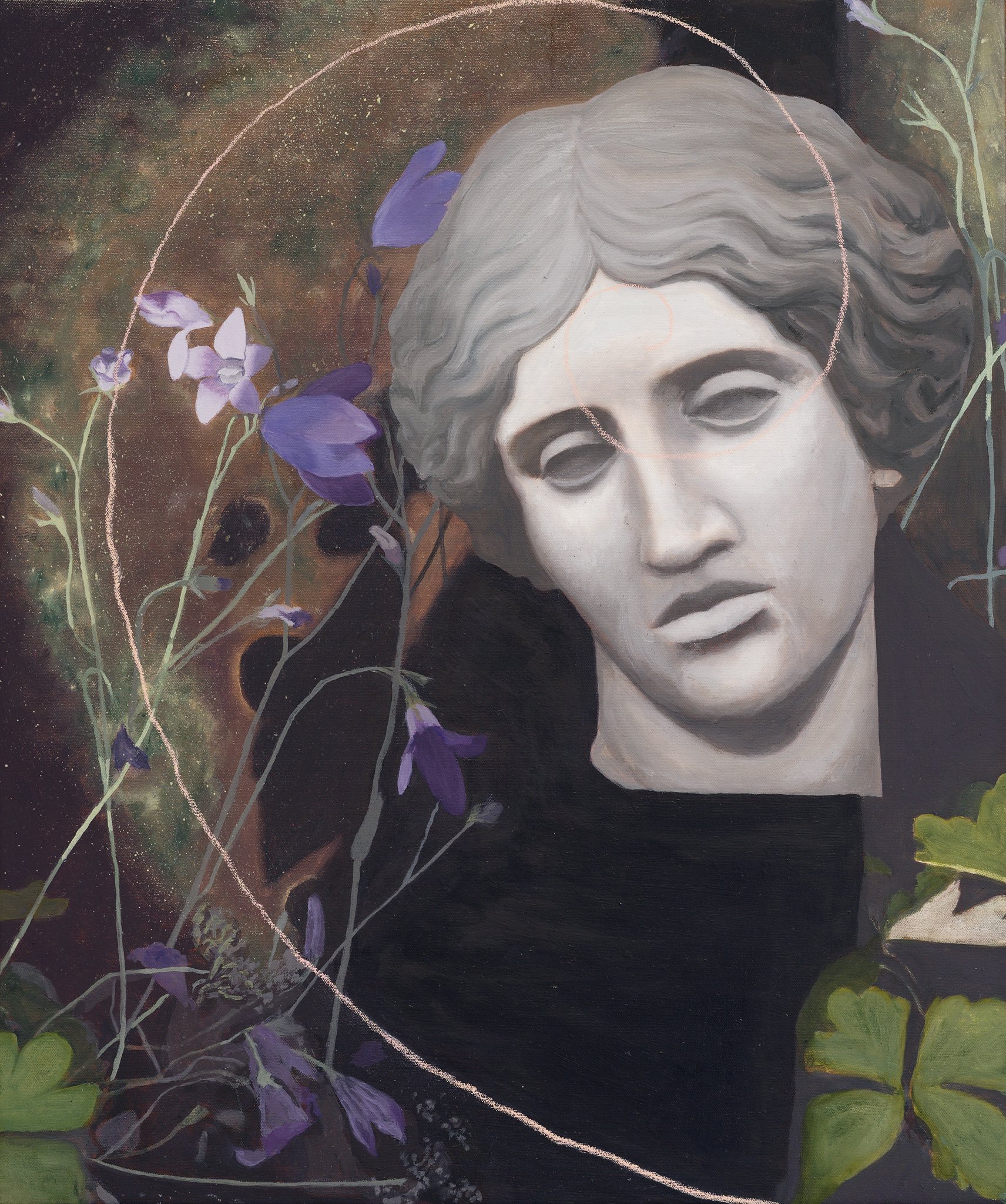
The head of a sculpture: stone-like, immovable, seemingly without feeling. Yet beneath her mask lies a fragile softness. She feels too much, too fast. Emotions spill before she can grasp them. So she retreats, not into peace, but into the soft void that waits beyond overwhelm. Her quiet is protection, a withdrawal where sensation is suspended and the world is held at bay.
Within that space, something stirs. She begins to spiral. At first it seems chaotic: wild, endless, out of control. But with time, expression, and a kind of inner alchemy, its meaning transforms. A map of ascent. A soul circling back to itself, shedding illusion with each turn. Each loop a rhythm, a pulse, a heartbeat.
The spiral is not collapse. It is becoming. Turning inward and outward, never returning to the same place.

This work explores the quiet power of intimacy, the feeling of being truly witnessed in your raw, unguarded being. It speaks to the deep human longing for safety, for a space where nervous systems co-regulate, and walls soften, where love is not just warmth but presence. To be held in someone's gaze without shrinking. To let yourself unfold in the presence of another. This is the beauty and the edge of connection.
Because love, when it is real, becomes a mirror - reflecting not only your light but your shadow, your longing, your patterns, your tenderness. In this space, vulnerability becomes strength. The self is not lost in the closeness but revealed. Slowly. Honestly. Without performance. This is not the drama of romance, but the still, transformative intimacy of being known.

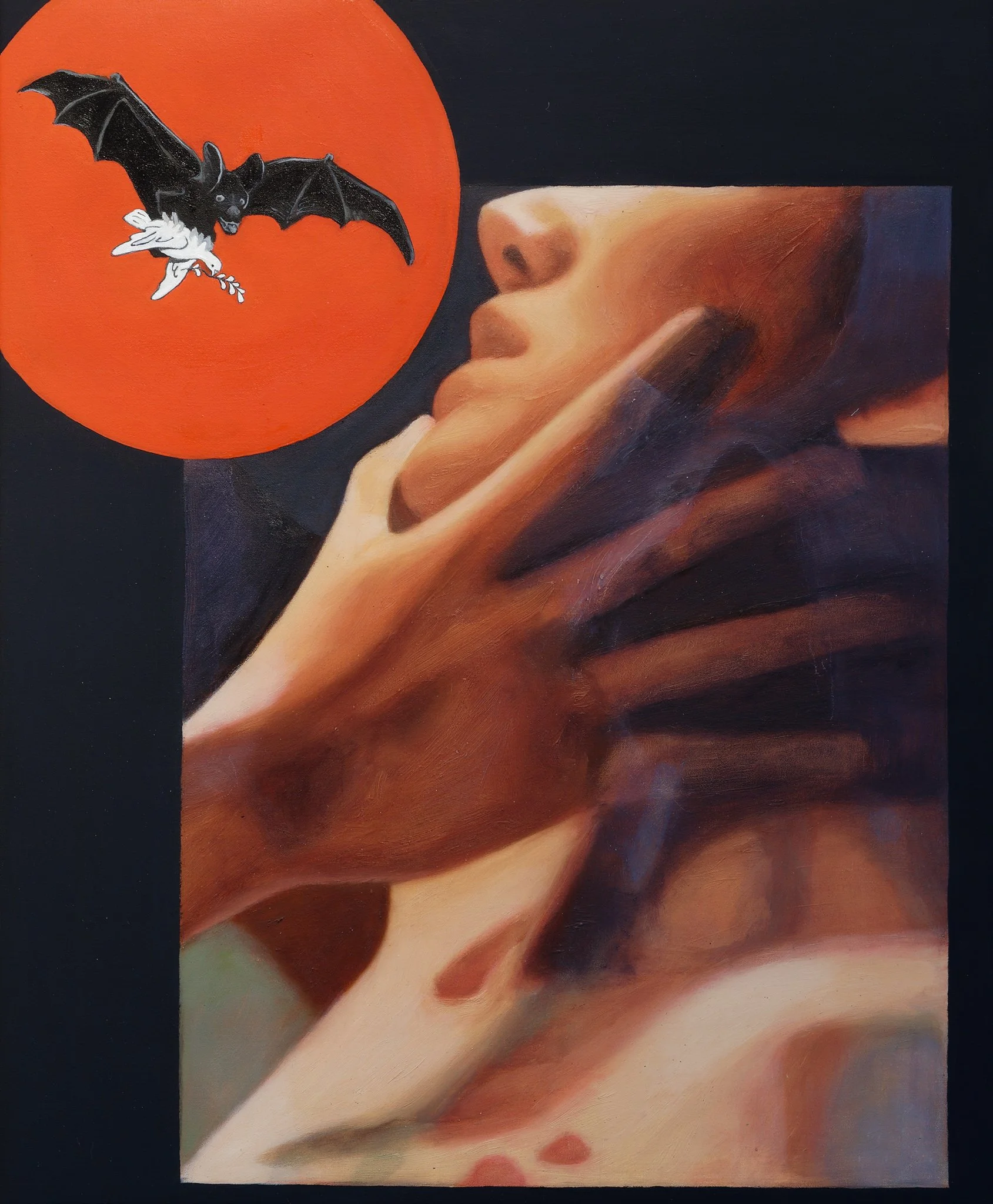
For almost fifteen years, I unknowingly befriended darkness. Grief became a way to keep her close. I moved through deep emotional cycles: long stretches of heaviness followed by periods of feeling 'fine', until the weight returned without warning.
I did not know how to feel the grief safely, so I suppressed it. And when it erupted, I indulged in it. The sadness made me feel connected to her, even as it quietly consumed me.
I began to imagine my pain as a swarm of bats. Dark companions I kept close. They brought comfort, but they disturbed my peace.
I could not see it then, but the cycle was seductive. It felt like love. It felt like familiarity. It was a quiet destruction. Holding onto the grief had become a way of holding onto her.
This painting explores that tension - the seductive pleasure of holding onto darkness, and the fear that releasing it means losing her altogether.

This work is a memento mori, a reminder that life ends, that time is short, and that everything we carry will one day fall away. But it is also about the quiet work of presence. The ongoing practice of reflection. The discipline of self-responsibility.
What remains bridges the tension between tending to what asks to be seen and allowing space to simply enjoy the moment. Between doing the work and remembering how fleeting this all is. You will not be here forever. So live.